
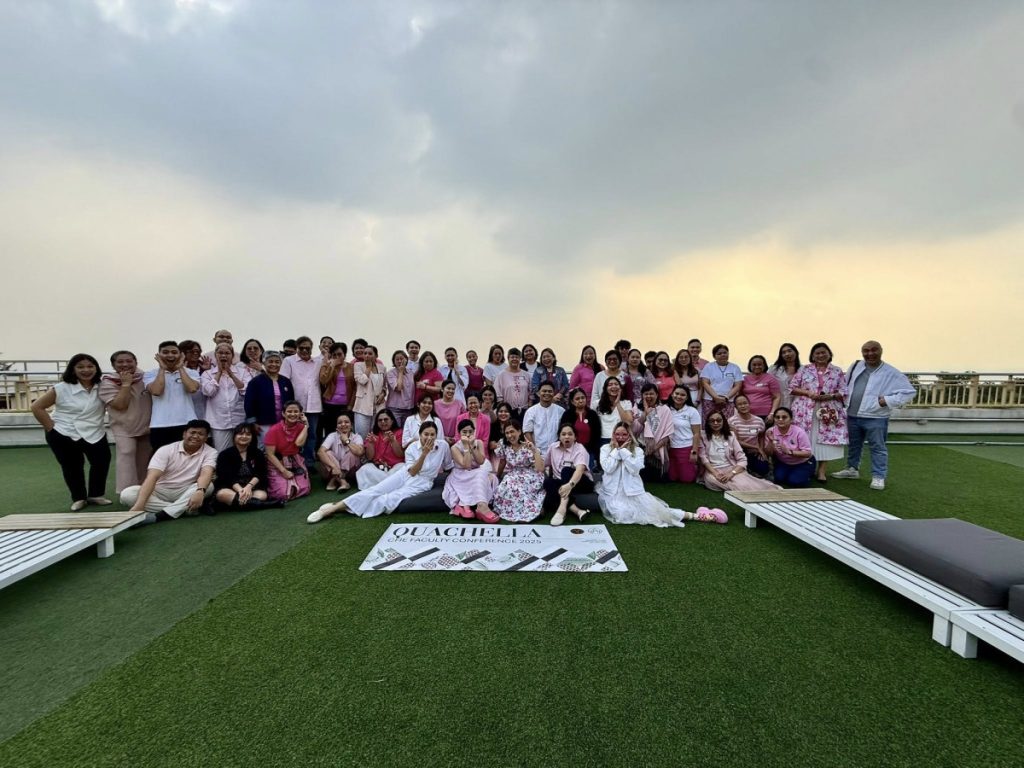
The College of Home Economics (CHE) successfully held its annual Faculty Conference, QUACHELLA 2025, from December 1 to 3, 2025 at Timberland Highlands Resort in San Mateo, Rizal. Conducted in conjunction with the anniversary of Home Economics as an academic discipline at the University of the Philippines, the conference served as a key faculty development initiative focused on strengthening teaching, research, and creative practice across the College.
With the theme centered on Creative Work alongside Research, QUACHELLA 2025 provided a platform for CHE faculty members to collectively examine how creative outputs and research endeavors can be meaningfully integrated into instruction, aligned with program learning outcomes (PLOs), and situated within the College’s quality assurance framework.
Revisiting Creative Work as Academic Practice
Organized by the Department of Clothing, Textiles and Interior Design (CTID), the three-day conference brought together faculty members from across CHE for a series of keynote lectures, panel discussions, workshops, and collaborative activities. The opening program featured welcome remarks by Dean Shirley V. Guevarra, followed by a keynote presentation on Creative Work as an Academic Endeavor in the University delivered by Dr. Michael L. Tan, former Chancellor of the University of the Philippines Diliman.
A panel discussion on Creative Work in the University further enriched the conversation, with insights from Dean Toym Imao, Director Monica Santos, and Dr. Alyssa Alampay, moderated by Dr. Excelsa Tongson. The session highlighted diverse perspectives on how creative work is conceptualized, recognized, and evaluated within the academic landscape.
From Dialogue to Practice: Workshops and Faculty Outputs
A central component of QUACHELLA 2025 was its workshop series, designed to translate reflection into practice. Workshop I, facilitated by Dr. Lizamarie Olegario, focused on defining and contextualizing creative work within CHE’s various subdisciplines. Faculty participants collaboratively articulated how creative outputs contribute to teaching and scholarship, culminating in group presentations and peer feedback.
The conference also placed strong emphasis on quality assurance and outcomes-based education. A keynote on Quality Assurance by Dr. Aura Matias set the stage for Workshop II, led by Dr. Joanne Bantang, which examined how research and creative work can be embedded in course assessments and mapped to program learning outcomes. These sessions enabled faculty members to reflect on alignment between instructional strategies, outputs, and institutional goals.
Strengthening Faculty Community
Beyond its academic objectives, QUACHELLA 2025 also reinforced collegiality and collaboration within CHE. Informal exchanges during meals and the Fellowship Dinner and QUACHELLA Music Festival fostered a sense of community, recognizing that academic work is sustained not only through rigor, but also through shared experience and mutual support.
Institutional Significance
QUACHELLA 2025 stands as a significant milestone in CHE’s ongoing efforts to strengthen faculty development and ensure the relevance and quality of its academic programs. The discussions and outputs generated during the conference continue to inform conversations on curriculum development, creative scholarship, and quality assurance within the College.
The successful implementation of the conference was made possible through the collective efforts of the CTID faculty and staff, led by Asst. Prof. Kristyn Caragay, CTID Department Chair, together with the organizing committees responsible for program development, administration, and operations.
As CHE moves forward, QUACHELLA 2025 remains a valuable reference point for how the College engages with evolving academic practices while staying grounded in its disciplinary foundations.